TIOBEインデックスで見る2026年5月のプログラミング言語人気ランキング
ソフトウェア品質の評価と追跡を専門とするオランダのTIOBEソフトウェアが毎月発表する「TIOBEプログラミングコミュニティーインデックス」(通称「TIOBEインデックス」)。 このTIOBEインデックスからは、それぞれ […]
スポンサードサーチ
ソフトウェア品質の評価と追跡を専門とするオランダのTIOBEソフトウェアが毎月発表する「TIOBEプログラミングコミュニティーインデックス」(通称「TIOBEインデックス」)。
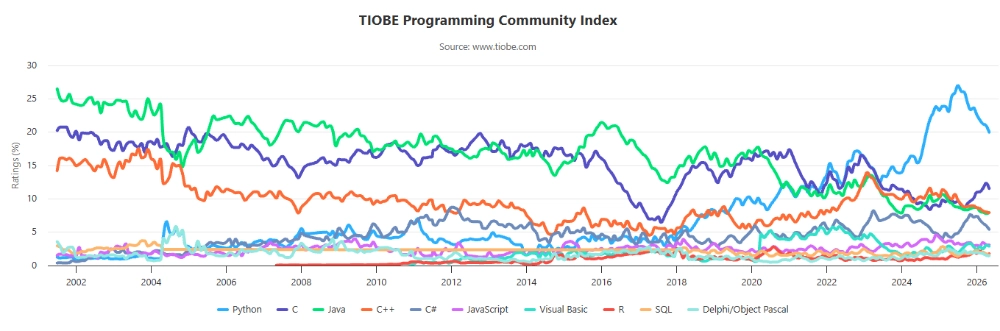
このTIOBEインデックスからは、それぞれのプログラミング言語がどれだけ話題になっているかがわかりますが、2026年5月のデータは以下の通り。
| 2026年5月 | 2025年5月 | 変化 | プログラミング言語 | レーティング | 変化 |
|---|---|---|---|---|---|
| 1 | 1 | Python | 19.98% | -5.37% | |
| 2 | 3 | C | 11.55% | +1.84% | |
| 3 | 4 | Java | 7.94% | -1.37% | |
| 4 | 2 | C++ | 7.92% | -2.02% | |
| 5 | 5 | C# | 5.41% | +1.19% | |
| 6 | 6 | JavaScript | 3.08% | -0.60% | |
| 7 | 8 | Visual Basic | 2.90% | +0.28% | |
| 8 | 12 | R1.77% | +0.31% | ||
| 9 | 10 | SQL | 1.57% | -0.33% | |
| 10 | 9 | Delphi/Object Pascal | 1.44% | -0.85% | |
| 11 | 11 | Fortran | 1.22% | -0.55% | |
| 12 | 14 | Scratch | 1.18% | -0.16% | |
| 13 | 16 | Perl | 1.18% | -0.02% | |
| 14 | 15 | PHP | 1.15% | -0.07% | |
| 15 | 19 | Rust | 1.14% | +0.21% | |
| 16 | 7 | Go | 1.12% | -1.58% | |
| 17 | 18 | Assembly language | 1.02% | +0.05% | |
| 18 | 23 | Swift | 0.93% | +0.16% | |
| 19 | 13 | Ada | 0.92% | -0.50% | |
| 20 | 17 | MATLAB | 0.89% | -0.13% |
統計プログラミング言語市場、大規模な再編へ
今月、プログラミング言語のRはTIOBEインデックスで再び8位にランクインし、過去最高値を更新しました。これは偶然ではありません。統計プログラミング言語市場は明らかに大規模な再編期を迎えています。最大の勝者はPythonとRであり、長年にわたり普及してきた多くの代替言語は勢いを失い続けています。統計計算環境が多くのニッチな言語やプラットフォームに分散していた時代は終焉を迎えつつあるようです。
いくつかの老舗プレイヤーは着実に順位を落としています。
MATLABは、TIOBEのトップ20圏外に転落寸前です。
SASは、TIOBEインデックスが開始以来初めてトップ30圏外に転落しようとしています。
Wolfram/Mathematicaは、過去のピーク時を大きく下回っており、さらに順位を落としています。
SPSSは先月、トップ100圏外に転落しました。
Sもトップ100圏外に転落寸前です。
Stataは、現在124位です。
一方、比較的新しい統計言語であるJuliaは、優れた技術的利点と学術界での関心の高まりにもかかわらず、長年にわたりTIOBEインデックス上位30位以内に入る、確固たる地位を築くのに苦戦してきました。今後の見通しとしては、Stanが来月TIOBEインデックスに初登場すると予想されており、これは確率的プログラミングとベイズ統計の重要性の高まりを反映しています。
実際、今日の統計プログラミング市場は、2つの主要なエコシステムを中心に展開しています。
Pythonは、産業界、機械学習、AI、そして本番システムにおいて圧倒的なシェアを誇っています。
一方、Rは、学術研究、疫学、および高度な統計分析において、依然として主要な環境としての地位を維持しています。
TIOBEインデックスの他の動向として、今月、JavaとC++が順位を入れ替えました。JavaはJava 26のリリース成功を受けて勢いを増しています。注目すべき上昇銘柄としてはZigがあり、初めてTIOBEインデックス上位30位に迫っています。Zigの人気上昇は、従来のシステムプログラミング言語と比較して、低レベルでのパフォーマンス、分かりやすいツール、そして比較的使いやすいという、他に類を見ない組み合わせによるものと考えられます。
— Paul Jansen TIOBE Software CEO
May Headline: Statistical Programming Language Market Undergoing Major ConsolidationThis month, the programming language R matched its all-time high by reaching position #8 in the TIOBE index once again. This is not a coincidence. The statistical programming language market is clearly undergoing a major consolidation. The biggest winners are Python and R, while many long-established alternatives continue to lose momentum. The era in which the statistical computing landscape was fragmented across many niche languages and platforms appears to be coming to an end.
Several established players are steadily declining:
- MATLAB is close to dropping out of the TIOBE top 20.
- SAS is about to leave the top 30 for the first time since the TIOBE index began.
- Wolfram/Mathematica remains well below its historical peak and is losing further ground.
- SPSS dropped out of the top 100 last month.
- S is also close to leaving the top 100.
- Stata currently sits at position #124.
Meanwhile, the newer statistical language Julia has struggled for years to establish itself as a stable top-30 language despite strong technical merits and growing academic interest. Looking ahead, Stan is expected to debut in the TIOBE index next month, reflecting the growing importance of probabilistic programming and Bayesian statistics.
In practice, today’s statistical programming market increasingly revolves around just two dominant ecosystems:
- Python dominates industry, machine learning, AI, and production systems.
- R remains the leading environment in academia, research, epidemiology, and advanced statistical analysis.
Elsewhere in the index, Java and C++ swapped positions this month. Java gained momentum following the successful release of Java 26. Another notable riser is Zig, which is approaching the TIOBE top 30 for the first time. Zig’s growing popularity appears to be driven by its rare combination of low-level performance, straightforward tooling, and relative ease of use compared to traditional systems programming languages.
— Paul Jansen TIOBE Software CEO
TIOBE Index for May 2026
スポンサードサーチ
関連記事
TIOBE INDEX 2026年9月版
TIOBE INDEXとは、プログラミング言語の人気を評価するための指標です。2026年9月版では、C言語がC++を抜いて2位に浮上しました。PerlとRubyがトップ20を外れ、AdaとObjective-Cが返り咲いています。
続きを読む →
TIOBEインデックスで見る2026年7月のプログラミング言語人気ランキング
ソフトウェア品質の評価と追跡を専門とするオランダのTIOBEソフトウェアが毎月発表する「TIOBEプログラミングコミュニティーインデックス」(通称「TIOBEインデックス」)。 このTIOBEインデックスからは、それぞれ […]
続きを読む →
TIOBEインデックスで見る2026年6月のプログラミング言語人気ランキング
ソフトウェア品質の評価と追跡を専門とするオランダのTIOBEソフトウェアが毎月発表する「TIOBEプログラミングコミュニティーインデックス」(通称「TIOBEインデックス」)。 このTIOBEインデックスからは、それぞれ […]
続きを読む →
WordPressからXヘ半自動投稿する仕組みをAIでブラウザ拡張機能として作ってみた
WordPressで記事を公開したら、そのままSNSにもアップしたい、というのは、多くのブログ運営者やメディア運営者にとって、ごく自然なニーズだと思います。 SNSの中でも、Facebookに対する投稿は、JetPack […]
続きを読む →